 Nekhbet

Cairo built, field proven
Engineering Sovereignty Into Every System
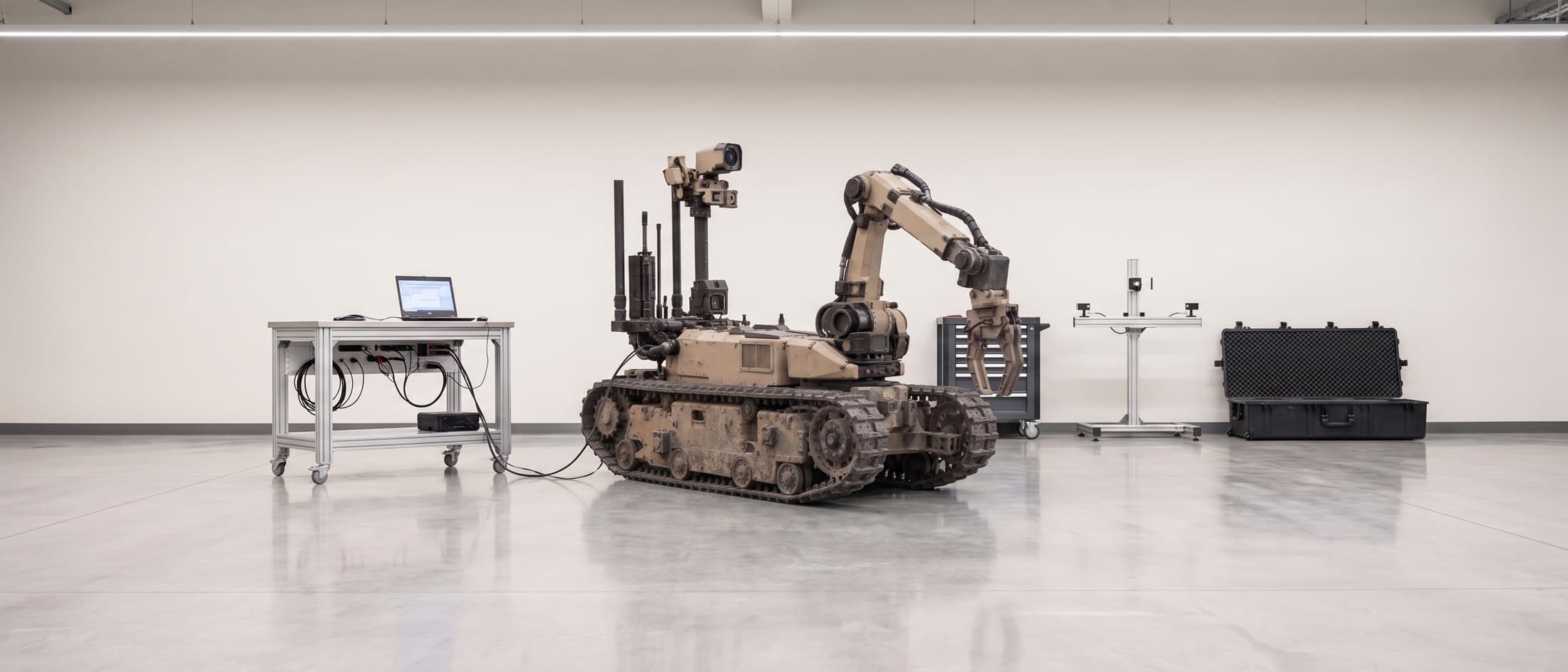
Nekhbet builds EV charging infrastructure, unmanned ground and air platforms, and on premise computer vision. Designed, integrated and supported in Egypt, so the system stays understood by the people who run it.
[01]The company
An Egyptian engineering house for systems that must remain understood, supported, and controlled locally.
Nekhbet Technology is an Egyptian advanced-technology company founded in 2021 and headquartered in 6th of October City, Giza. We engineer physical and digital systems for energy, security, and autonomy. Our work spans private and commercial electric-vehicle charging, unmanned ground platforms, mission-configured aerial systems, and on-premise artificial intelligence.
[02]Business units
Four operating units
[03]Why Nekhbet
Five differentiators
Built Around the Mission
We begin with the operating scenario, hazards, interfaces, users, and acceptance evidence. Product configuration follows the mission rather than forcing every customer into one catalogue setting.
Control Remains Local
Core administration, data, service knowledge, configuration records, and integration access remain available inside Egypt, reducing dependence on remote vendors for routine operation and recovery.
One Engineering Baseline
Mechanical, electrical, embedded, communications, software, and data changes are recorded against one configuration, allowing testing, service, and future modifications to remain traceable.
Designed for Real Conditions
Ambient heat, dust, power quality, communications availability, language, installation practice, service access, transport, and operator workload are addressed before a system reaches the field.
Supported Beyond Delivery
Deployment includes documentation, training, commissioning, spares planning, maintenance routes, incident escalation, and controlled update policies so capability remains usable after acceptance.
[04]Proof
What stands behind it
In-House System Design
Requirements are translated into mechanical, electrical, embedded, software, data, and interface definitions under one accountable engineering process.
Local Manufacturing Path
Designs are prepared for local fabrication, assembly, integration, inspection, and progressive localization, subject to program-specific qualification and supply-chain approval.
On-Premise Sovereignty
Operational data, models, logs, and administrative control can remain inside the customer perimeter, including offline and fully air-gapped operating modes.
Field Integration Support
Site surveys, interface definition, installation planning, commissioning, operator acceptance, and defect closure connect the product to the real operating environment.
Multi-Discipline Integration
Power, mobility, sensing, communications, software, analytics, human-machine interfaces, and external systems are treated as one controlled technical baseline.
Lifecycle Support
Documentation, spares planning, training, preventive maintenance, repair, controlled updates, obsolescence review, and configuration records support sustained service after delivery.
[05]Quality and compliance
Claims are released only when the evidence, product configuration, and approval scope agree.
No. A standard may be relevant to a product without that product having been tested against it. We list applicable references as references, and we publish a certification mark only when an authorized body has issued a valid certificate for a defined scope.
A specification goes live only when the released value, the evidence behind it, and the approval scope agree. Values still under engineering release are held back rather than estimated, because a pending value on a public page is a publication blocker.
Not automatically. A test may cover one prototype and one configuration. Test and certificate evidence has to match the commercial model, hardware revision, software version, options and manufacturing location being advertised.
Public pages carry brochure-level capability only. Restricted performance, communications architecture, effectors and program interfaces are never placed in the public site; they move through a separate controlled-datasheet process for qualified end users.